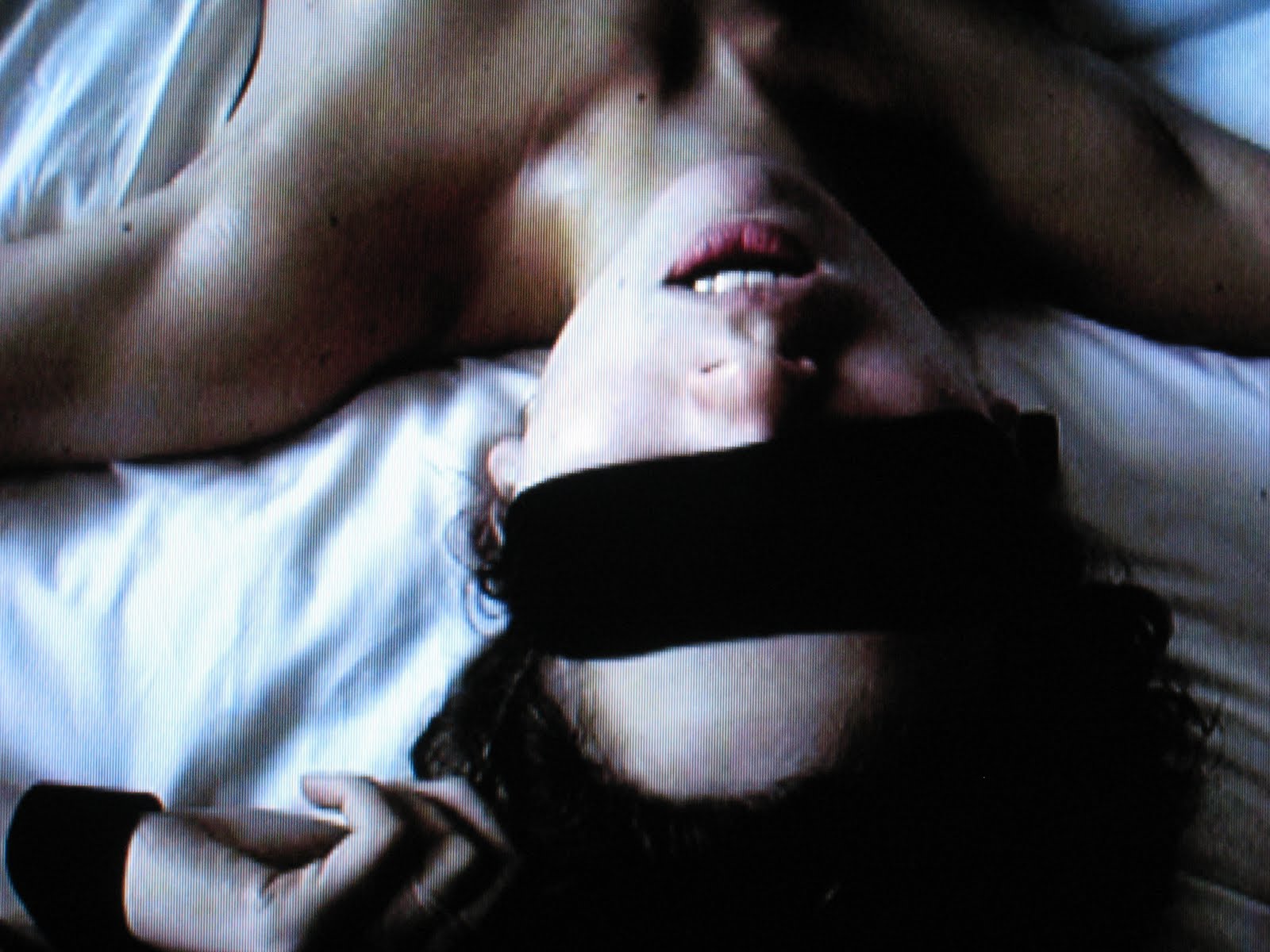
Showing posts with label real sex. Show all posts

Monday, 13 December 2010

Antichrist: Chaos reigns

CHRISTMAS SPECIAL

DIRECTED BY Lars von Trier, 2009
STARRING Charlotte Gainsbourg, Willem Dafoe
CERTIFICATION 18: Contains strong real sex, bloody violence and self-mutilation
RUN TIME 104 mins, Chelsea Films

COVER QUOTE 'Twisted, depraved and troubling… and also utterly brilliant' - Dave Edwards, The Mirror

WHY YOU SHOULD SEE IT Antichrist was largely ridiculed when it first screened at Cannes: jeers and laughter were followed by boos from the audience, amid isolated applause. Word quickly spread of the film's extremely violent sexual content, which reaches its peak with an extremely graphic image of female self-mutilation. Von Trier explained that he had been clinically depressed at the time of making the film and this was his way of working through those feelings. The Dogme-tic director called Antichrist, 'the most important film of my entire career'. NB It's entirely possible you may not want to read beyond this point, and I wouldn't blame you. Not one bit.

THE PLOT Prologue On a snowy night, in a beautiful, luminous black-and-white that's almost a parody of good taste, von Trier shows Gainsbourg and Dafoe having sex, to the accompaniment of a washing machine, while their baby son, Nic, falls from their apartment window to the snow-covered pavement below.

Chapter 1: Grief Charlotte Gainsbourg's character (I'm going to call them by the actors' first names, let's hope it doesn't get too confusing) collapses at Nic's funeral; the next time we see her is in hospital, one month later. Her husband, Willem (I know, but I'm going to plough on), a therapist, insists on overruling her doctor and takes Charlotte home for treatment. They work through a series of mental exercises together, which includes identifying her biggest fear. This, it seems, is centred on their country cabin, Eden; they travel there to confront her trauma. Willem sees a doe with an apparently dead fawn hanging from her hindquarters.

Chapter 2: Pain (Chaos reigns) Charlotte is suddenly overcome with terror and runs to the cabin, where Willem finds Polaroid pictures of her trip there in the summer with their son. Her antipathy towards Willem is heightened; she describes a scene from her earlier holiday when she could hear a baby crying even though Nic was fine. Willem this time comes across a bloody fox eating itself. It speaks the words: 'Chaos reigns.'

Chapter 3: Despair (Gynocide) Gynocide is the title of the thesis Charlotte was working on when she visited the cabin in the summer; climbing into the attic, Willem discovers her abandoned thesis, among many disturbing images of women being punished. In her notebook, Charlotte's writing deteriorates to an alarming scrawl. In a role-play game, Charlotte identifies with the arguments used against the women in her work.

Charlotte discovers Nic's autopsy report, which Willem has been hiding from her. In it, the coroner notes an earlier deformity of the bones in Nic's feet; in the Polaroids, Willem sees that Charlotte put Nic's shoes on the wrong feet. Charlotte attacks Willem, this time with a hatred and intensity not seen before, knocking him out and then attaching a metal weight to his leg. When Willem wakes he manages to crawl away and hide in a fox hole Charlotte has previously identified. She finds Willem's hiding place, drawn by the cries of a crow with which he is buried, and attacks him with a spade.

Chapter 4: The Three Beggars Charlotte rescues Willem from the foxhole and drags him back to the cabin. 'Do you want to kill me?' he asks. 'Not yet,' is the less-than-reassuring response. She is, she says, awaiting the arrival of the 'three beggars', at which time 'someone must die'. She remembers the opening scene of Nic's death; Charlotte saw him open the window and climb to his death. She cuts off her clitoris with a pair of scissors and then goes into the woods. Willem finds a wrench and manages to remove the weight from his leg; when Charlotte finds him she stabs him with scissors but Willem grabs her and strangles her. He burns her body in front of the cabin, an image filled with hundreds of bodies on the hillside.

Epilogue Willem leaves, watched by the three beggars: crow, deer and fox. Hundreds of faceless figures surround him.

THE FILM Antichrist was my Number One film for 2009. I saw it with a woman friend; you'll have gathered it's not a date movie. Its emotional effect is perhaps diminished with time but Antichrist does repay repeat viewings, and remains shocking.

Von Trier's film has a definite look, from the pristine black-and-white of the prologue through the seeped colours of the funeral scene. Willem Dafoe's early appearances are reminiscent of Tilda Swinton in Tony Gilroy's exemplary corporate drama Michael Clayton (2007) playing a very different role: the character Willem is accused of being aloof, and this is underlined by the blues and greys of his suits and settings. 'You've always been distant,' Charlotte says. 'Okay, can you give me some examples,' he replies. (I think this is supposed to be funny, and it is.)

Willem's arrogance is the initial root of the problem: a therapist, he ignores the dictum never to treat your own family and believes he is smarter than the younger doctor treating Charlotte. 'Trust others to be smarter than you,' she pleads, 'you're not a doctor.' But this is a dick thing, and his penis becomes a target when Charlotte seeks to punish him. When they get home and Willem can begin to work on her, she adds: 'I never interested you until now.' (It is very easy to imagine Charlotte Gainsbourg in the role of trophy wife.)

But there is something darker lurking under the surface, as von Trier shows us in the last shot in Charlotte's hospital room, when his camera zooms in on the murky, green water in a flower vase, rooting among the rotting stems. Antichrist moves into classic horror movie territory: the countryside, but here the enemy is not zombies, or malevolent yokels, but nature, notably women's nature. 'Nature is Satan's church,' according to Charlotte. And, later, 'Women do not control their own bodies, nature does.'

They set off to their woodland cabin, Eden, which is plagued by noisy acorns, which drop noisily on the roof, and ticks, which gorge themselves on Willem's exposed flesh. Willem is demonstrably unprepared for the countryside, equipped only with his smart overcoat and trendy bag as opposed to Charlotte's waterproof slicker and rucksack. 'You were the one who always wanted to go,' he chides, revealing a split in their relationship.

Last summer she went to the cabin with their son, Nic, but Willem did not join them. While there she worked on her aborted thesis, which perhaps provoked a previous breakdown, unnoticed by therapist Willem. An early breakthrough is thwarted when a fledgling chick falls out of tree (almost as in Breillat's Anatomy of Hell), is infested with ants, and then plucked up and eaten by a bird of prey. She attacks Willem for coming to her place: 'You shouldn't have come here, you're just so damn arrogant.'

The film's end credits list a series of researchers in a salutory range of specialisms: misogyny; mythology and evil; anxiety; horror films; music (the haunting theme used at the film's beginning and close is Lascia ch'io pianga, from Georg Friedrich Handel's opera Rinaldo); theology, and therapy (therapeutic consultants and teacher, rather, which is not quite the same thing). The denouement is an orgy of bloody sexuality, excruciating violence and animal cameos that unexpectedly fulfills Charlotte's prophecy: 'When three beggars arrive, someone must die.'

Dafoe the actor emerges in heroic mode - it's impossible not to think of his deserted figure in Platoon (1986), then set to Barber's Adagio for Strings. Framed against the hillside here, he has crafted a crutch from a branch and kneels to pick berries: the very outdoorsman, he has vanquished the wild west of womanhood.

KEY SCENES Chapter 1, 00:27 Charlotte and Willem are having sex in the shower; von Trier shows the snow outside, steam exiting through a vent, and a penis during intercourse. (Dafoe and Gainsbourg had body doubles: porn stars Mandy Starship and Horst Stramka.) All the while, the couple's baby, Nic, climbs out of his cot and pushes a chair underneath a window. Nic climbs up onto the sill; his look of wonder at the falling snow is reflected in Charlotte's absorption in the act of sex, and an air of completeness, satisfaction, at its end.
Chapter 8, 1:05:30 Following her breakdown, Charlotte seems to an aquire a frantic physical need for sex, this culminates in a scene in the cabin where she mounts Willem and tells him to hit her 'so it hurts'. He refuses and she runs out, naked, into the woods: beneath a tree, she masturbates furiously before Willem joins her and they have sex. The roots of the tree are filled with grasping hands - this image, or forms of it, was used on many posters for the film at the time of its cinema release.
Chapter 9, 1:11:57 Charlotte throws herself on top of Willem, then staves in his crotch with a substantial log. When she notices his erection, even though he has passed out, she jerks him off until he ejaculates blood. This is when she goes for a toolbox and, using a hand drill, attaches a round weight through his leg.
Chapter 10, 1:27:20 Charlotte kisses Willem, undresses and lies next to him, pulling his hand between her legs. Following a flashback to the night of Nic's death, the moment when she cuts off her clitoris is shown in detail.

FURTHER VIEWING Where to begin with von Trier? There's Dancer in the Dark (2000), which seemed to drive pop star Björk almost to breakdown (von Trier claimed she tried to eat her dress on set); The Idiots (1998), probably the single film that allowed him to put such strong images as those in Antichrist on the screen; or incredibly spooky TV series The Kingdom (1994), set in a hospital peopled with a gallery of eccentric and unforgettable characters. Then there's Beneath the Waves (1996), which features an incredible central performance from Emily Watson, and is one of the most shockingly blasphemous pieces of cinema you'll ever see. Wonderful.

KEY QUOTE 'Never screw your therapist' - Willem Dafoe's character

Merry Christmas and have a very happy 2011!

Monday, 15 November 2010

In the Realm of the Senses: Empire state

ALSO KNOWN AS Ai no korîda, L'empire des sens

DIRECTED BY Nagisa Oshima, 1976
STARRING Eiko Matsuda (Sada Abe), Tatsuya Fuji (Kichizo Ishida)
CERTIFICATION 18
RUN TIME 98 mins approx, Nouveaux Pictures
LANGUAGE Japanese

COVER QUOTE 'The expression of total passion' - The Times

WHY YOU SHOULD SEE IT Four years after hardcore Deep Throat, and two years after the soft-focus Emmanuelle, director Oshima distilled the desperation of sex for this exceptionally explicit arthouse movie. This version is available uncut though, crucially, one scene involving a very young child has been panned and scanned.

As the closing narration explains, Oshima based his film on a true story of a murderous affair which took place in Tokyo in 1936 and saw Sada Abe being treated as something of a folk hero in Japan. The insular complicity portrayed between the two protagonists means the film is not wholeheartedly moving but it is an extraordinary vision of sexual obsession.

THE PLOT Former prostitute Sada works in an inn, where she and another maid spy on the owner, Kichizo Ishida, and his wife having sex. When Sada is maligned as a whore she breaks into a furious row, which has to be broken up by Kichi. Kichi makes a pass at Sada when she is working and the two begin an affair, first in the inn and then visiting neighbouring hostels. At one, the couple stage a wedding celebration.

The couple become notorious with the staff at places where they stay for remaining confined in their rooms, barely eating but drinking and fucking all the time. Sada arouses Kichi's jealousy when she goes to visit a client while Sada herself becomes increasingly possessive of Kichi, threatening to cut off his penis if he ever has sex with his wife again.

The affair becomes more intense as the couple introduce strangulation into their intercourse. Sada strangles Kichi, apparently with his previous understanding, and then cuts off his penis. According to the closing vioceover, she wandered the streets of Tokyo gripping his dismembered member for four days before she was arrested.

THE FILM When Kichi first meets Sada she is wielding a knife. He lewdly implies she should be holding his penis instead and, for much of the rest of the movie, she is grasping one, the other, or both. Famously, a knife is finally applied to his penis, fatally.

In the Realm of the Senses opens with a scene of a homeless drunk being abused by some children. When Sada goes to his aid, he recognises her, claiming he used to visit her as a client. He begs one last encounter, offering to pay, and, momentarily, she takes his penis before being called away. There's an immediate sense of the power sex has over her and, perhaps, her own sexual power, which may have reduced this man to the gutter.

Sada is aware of her own attraction to sex and it is important for her, early in her affair with Kichi, to distinguish it from madness. 'I'm not sick,' she says; she's visited a doctor, showing the level of her concern: she's not a nymphomaniac, or any other tawdry diagnosis that might be applied, but 'hypersensitive'.

There is, also, an early indication of her propensity for violence: when she sees Kichi being shaved by his wife, Sada imagines taking the blade and attacking the woman. The scene which has been optically altered shows her tugging a small boy's penis, an image that would likely be deemed indecent under the Protection of Children Act.

Kichi is initially portrayed as a dissolute, if charming, drunk, prone to giggles and singing. He is fascinated by Sada's youth ('I'm no longer so young - how I envy you') and, as her madness grows, increasingly falls under her spell. He is the first to take her by the throat but the roles change as he says he can't bear to see her suffer. He allows her to throttle him with growing force for the pleasure it gives her (it is unclear if he is afforded any thrill beyond her enjoyment). Alongside some outdoor shots, these later scenes are some of the most beautiful in the movie as they achieve an almost mesmeric quality as she rides him in the throes of her orgasm.

Much of the film concentrates on his penis: it is shown erect, Sada fellates him or, at other times, holds a knife to it. When he wakes one morning, he finds her playing with it. 'Did you hold it all night,' Kichi asks. 'Of course.' 'It's as if he was yours,' he says later. 'He is.' Sada even has him piss inside her though, at another time, Kichi muses this is the only time his penis can rest. When they go home, she leads him by his penis and, of course, it becomes the focus of her threats: 'If I cut him off will you die?' 'Probably.' 'Then I don't want to.'

They do venture out, if only to go home or earn some money, and the outside world is an unwelcome visitor on their frolics. Maids criticise the state of their room - smell is especially important to Sada, while both partners enjoy the feel of each other's skin - encourage them to eat or, at least, to have less sex. They seem particularly shocked by Sada's continual willingness to suck Kichi's cock. At one point Kichi is warned, 'She'll end up killing you.'

By then, they are so wrapped up in their perpetual orgy, this prophecy is accepted as inevitable. Sada seems to achieve one incredible, final, orgasm at his death; in blood, she writes on her lover's body: 'The two of us, forever.'

KEY SCENES Chapter 2, 14:05 Kichi has Sada mount him at his home while she plays a musical instrument to cover for his wife. After sex she sucks his penis while he smokes a cigarette.
Chapter 3, 26:06 Sada and Kichi have sex in front of a group of women musicians. One of the women is deflowered by the others using a dildo carved in the shape of a bird before they all join in.
Chapter 4, 40:36 Kichi rapes the elderly madam of the inn where he and Sada are staying while Sada goes to visit a client, a school principal, to earn some money. She urges the ageing teacher to hit her, first across the face, then pinch her and pull her hair.
Chapter 5, 49:26 Sada 'lays' an egg that Kichi has inserted in her vagina, a surrealist image worthy of Georges Bataille. In his Story of the Eye (1928), protagonist Simone indulges in just such behaviour.
Chapter 7, 1:10:30 Sada urges Kichi to have sex with a 68-year-old woman, who pisses herself at the act's conclusion.
Chapter 8, 1:17:54 Kichi allows Sada to tie a belt around his neck which she tightens as they have sex.

WHAT HAPPENED NEXT In the Realm of the Senses was critically acclaimed when it arrived at the 1976 London Film Festival, where it won the critics' prize. To avoid cuts, the film was shown in cinema clubs and was only first submitted to the BBFC in 1989.

The film was passed uncut for cinemas in 1991 - optical tinkering for that one scene notwithstanding - largely due to the wealth of critical opinion that had built up behind it. This would support a defence of artistic merit if any prosecution under the Obscene Publications Act was sought. (A friend who saw it at the time only said it confirmed her antipathy towards eggs.) Video/DVD release was officially achieved in 2000. (Virgin had released an uncertificated version in 1982 but it was withdrawn in 1984 when the Video Recordings Act became law; it demands BBFC approval for any release.)

Oshima went on to make such films as Merry Christmas Mr Lawrence (1983), starring musicians David Bowie and Ryuichi Sakamoto alongside director Takeshi Kitano, and Empire of Passion (1978), another eroticised telling of a true murder tale, from 1895, about a peasant woman and her younger lover, who conspire to kill the woman's husband. Afterwards they are pursued by his spirit and overcome with guilt.

KEY QUOTE 'Instead of a knife you should be holding something else' - Kichi

BONUS CURIO (1) To avoid prosecution in Japan while shooting, the film was listed as a French production and undeveloped footage shipped to France for processing and editing.
(2) When Oshima struggled to find anyone to play Sada Abe because of the controversial nature of the material his actress wife, Akiko Koyama, offered to take the role.

Monday, 4 October 2010

Battle in Heaven: Flag bearer

DIRECTED BY Carlos Reygadas, 2005
STARRING Marcos Hernández (Marcos), Anapola Mushkadiz (Ana), Bertha Ruiz (Marcos' wife)
CERTIFICATION 18: Contains strong real sex
RUN TIME 94 mins approx, Tartan
LANGUAGE Spanish

COVER QUOTE 'Beautiful and utterly compelling. Carlos Reygadas makes films like no one else in modern cinema' - Esquire

WHY YOU SHOULD SEE IT Director Reygadas provoked controversy with his intergenerational sex scene in debut movie Japón (2002) which featured a non-professional cast. The posters for Battle in Heaven have the very beautiful Anapola Mushkadiz lying naked to her waist on a bed, which is surrounded by clouds. Much was made of the movie's 'real' sex scenes.

THE PLOT Marcos, a chauffeur for an army general, is sent to meet his employer's daughter, Ana, at the airport and takes her to the high-class, suburban brothel where she works. She tells him to come in for sex with one of her colleagues but it emerges that he wants to have sex with Ana. She spots that he is out of sorts and he admits that he and his wife kidnapped a baby who died. His wife fears that he will give everything away but Marcos promises Ana that he will give himself up to the police. Before he does so he visits Ana at her boyfriend's flat; Marcos leaves but then returns and stabs her. He joins a religious procession on his knees and has a sack placed over his head; blood emerges and he collapses in the Basilica.

THE FILM Despite visual and structural differences, Carlos Reygadas's Battle in Heaven shares several themes with Y tu mamá tambien, by his Mexican compatriot, Alfonso Cuarón. Both films have an interest in the urban landscape of Mexico City - plenty of shots of its streets - sexuality and class, though only Reygadas goes so far as to explicitly mix the last two themes.

In Battle in Heaven's central scene, middle-aged chauffeur Marcos sleeps with his young charge, Ana, the daughter of his boss. Their relationship doesn't just transgress class and age boundaries but, as Ana points out, Marcos has known Ana for 15 years, since she was a child.

In the manner the camera sometimes goes for a wander in Cuarón's film, it does so here, scanning across neighbourhood rooftops, showing aerial repairmen at work, the city's skyline, and a dripping tap, before returning to the bedroom and a shot of the couple's genitals. The couple are tender with each other after sex: Ana's hand inches over to take that of the older man, her servant.

Reygadas had known Marcos Hernández, who plays Marcos, as he had worked as a driver for 30 years at Mexico's ministry of culture, where Reygadas' father worked. The thickset woman playing Marcos's wife, Bertha Ruiz, is the wife of a regional police commander. Her husband's only concern was that her sex scene be simulated. Reygadas is essentially transferring Catherine Breillat's filmic philosophy to central American and, indeed, extending it, through his casting of non-professionals.

The BBFC certificate for Battle in Heaven warns that it includes 'real' sex scenes and much of the pre-release hype focused on that. But the scenes, though more explicit than most in cinema (for instance, the blow jobs that bookend the film, or the shot of Ana's genitals), are not so explicit that they are definitely real. The BBFC ends up in a strange position here, advising viewers that convincing sex scenes are authentic, though they may be simulated (there's no reason a prosthesis couldn't be used for the blow job scenes).

There is a spiritual side to Reygadas' film that's more obvious than that in Y tu mamá también. When Marcos first sees the pilgrims whose procession he later joins, he is at a petrol station where the blaring classical music seems to have sent him into a fugue state. 'What do you think?' asks the mechanic, as he checks the oil. 'They're all sheep,' Marcos says. 'I was talking about the car,' comes the succinct reply.

Slowly Marcos' attitude changes: in bed with his wife he stares at a portrait of Jesus.
His wife urges Marcos not to give himself up but, if he is determined, to at least wait one more day so they can join the pilgrimage: 'Something special is going to happen,' she says, 'Something's going to change.' As it is, the extra day is the one on which he murders Ana, provoking a police hunt. Marcos' son reveals the location of the dead body of the baby that was kidnapped while his wife is taken to the procession to help spot her husband. (The policeman in charge of the operation looks and acts like a Mexican Takeshi Kitano, if you can imagine.)

When all the celebrants have left the Basilica, Marcos' wife is given permission to enter first to find her husband. Her husband's body is kneeling in a pew, a blood-soaked bag over his head. She reaches out to touch his shoulder and his body slumps to the floor. It starts to rain, and the next scene is of men trying to ring the massive church bell, though no sound is heard on the soundtrack.

This is followed by a recurrent scene in the movie, of soldiers either raising or lowering a giant Mexican flag, a ceremony Marcos has followed religiously in the past. It is accompanied by loud military music, and other scenes have very loud music, for instance Bach at the garage or Tavener's The Protecting Veil. It serves as jolting a purpose as the voiceover in Y tu mamá también.

It's possible to think of the opening scene, where Ana fellates Marcos, as Marcos' fantasy. Its repetition at the film's end hints at something else made manifest - a meeting in heaven, or Marcos' dying dream?

KEY SCENES Chapter 1, 00:40 A sweaty, middle-aged man, Marcos, with a combover and paedo glasses is shown getting a blow job from an equally naked young woman, Ana, against a grey backdrop. The camera tracks down his standing body and then round her kneeling figure till we're facing her; a tear trickles down one cheek.
Chapter 7, 37:07 Marcos is shown having sex with his hefty wife from behind. As she kneels on the bed he regards her back and an icon of the wounded Christ on their bedroom wall.
Chapter 9, 48:18 Ana is riding Marcos naked in bed; as they have sex the camera moves out the window and tacks across the skyline before returning to the couple. She gets off him and, as they lie side by side, the camera shows her pussy.
Chapter 15, 1:29:36 Ana is again shown giving Marcos a blow job in the space with the grey backdrop. Both are noticeably more relaxed and happier; they say that they love each other.

WHAT HAPPENED NEXT Reygadas went on to make the beautiful, mystical Silent Light (2007), set among the Mexico's Mennonite community. A fan of Carl Theodor Dreyer's work from his time as a potential film student in Brussels, Reygadas borrows the ending to the Danish director's film Ordet (1955). There are again the everyday sex scenes he likes to show, amidst another cast of non-professionals.

KEY QUOTE 'What you really want is to fuck me, right, Marcos?' - Ana

BONUS CURIO (A Brush with Nipples, Part III) Mushkadiz's hair extends wildly for the cover of the US DVD (in the UK, the film's title was emblazoned over her chest):

Tuesday, 17 August 2010

Baise-Moi: Grrls with guns


DIRECTED BY Virginie Despentes, Coralie Trinh Thi, 2000
STARRING Karen Lancaume as Karen Bach (Nadine), Raffaëla Anderson (Manu)
CERTIFICATION 18: Frequent/very strong language, sex/nudity and violence. Some hard drugs use
RUN TIME 73 mins approx, Universal
LANGUAGE
French

COVER QUOTE 'The most extreme thriller you'll ever see legally' - Uncut

WHY YOU SHOULD WATCH IT A censor's worst nightmare: sex and violence. Based on a 1994 novel by Virginie Despentes, who worked as a prostitute after she was raped aged 17; co-director Coralie Trinh Thi was a porn actress, as were the film's two stars.

THE PLOT Manu and a friend are picked up by three men and raped in a warehouse; later she fights with her brother and shoots him dead. Nadine, a prostitute, falls out with her flatmate and apparently kills her; Nadine goes to join her fixer friend Vincent but sees him shot and killed. Manu and Nadine run into each other by chance and agree to drive to Paris together; Manu forces Nadine at gunpoint to take them to the coast.

In the morning they agree to join forces and embark on an unpremeditated killing spree. Their targets include: a woman at a cash till who they mug; a man (who they kick to death) who picks them up but refuses to have sex without a condom; two policemen, and the entire clientele of a 'fuck club'. They stay in hotels and pull random men for sex while a major hunt is underway for them. At a roadside café, Manu is killed; Nadine rescues her body and sets fire to it. The next morning Nadine intends to kill herself but is caught by the police.

THE FILM The theft by a boiler repairman (that's not a euphemism) of a few of my DVDs more than a year ago was the partial inspiration for this blog. I immediately spotted that one of the films he had taken was Julio Medem's excellent Sex and Lucía, but it was only recently that I realised another of the DVDs he lifted was Baise-Moi, and this became the catalyst for me to finally get writing.

There's a lot in Baise-Moi to get worked up about: the rape, the mindless violence, the close-up shots of genitalia... But it's not as offensive as Gaspar Noé's Irreversible, say, and in its madcap, freewheeling way, is almost likeable. Widely portrayed as Thelma and Louise with guns - and full-on sex, and drink, and drugs, and no morality, and little sense of its own structure - it's hard to be truly offended by this film. That's not to say you won't be shocked.

Baise-Moi isn't the first time hardcore actors have been cast in a 'mainstream' (in the sense that dsitributors hoped it would be shown in general city-centre or, at least, art-house, cinemas) film: Catherine Breillat cast Rocco Siffredi in Romance (1999), for instance, and has used him since; Steven Soderbergh had Sasha Grey as the lead in his strangely asexual 2009 movie, The Girlfriend Experience. But here, the main artistic core of the movie seems to have been taken over by practioners from the porn industry: Trinh Thi, Lancaume, Anderson... What seemed to inflame matters further was that they were all women. These girls were doing it for themselves.

One neat little gag (the only one) comes when Nadine recognises Manu from porn films. Manu assumes that Nadine must have been forced to watch them with a boyfriend but, as we're shown early in the film, Nadine is happy to enjoy them on her own. (The glimpse we see implies that she watches violent porn.)

When Nadine visits a client, the film playing in his room, which she's more interested in than his promise to make her come, is Gaspar Noé's Seul Contre Tous (1998). Noé is thanked at the end of the film and his filmic philosophy serves as some sort of inspiration for Baise-Moi: his is an almost nihilist cinema of style over substance, despair over hope, degradation over ambition and shock over awe. One clip Despentes and Trinh Thi show from Seul Contre Tous exemplifies the level all three directors, including Noé, are working at: his butcher hero slicing a sausage.

At one moment in Baise-Moi, Manu kills a man who crudely tries to pick her up in the street but the violence is not simply meted out to men who cross the line. Women are dispatched with even less care as there is no reason to kill them; 'Where are the lines?' complains Manu, mourning the James Bond aspect of murder we've all become inured to in big-screen action movies. 'People are dying, the dialogue has to be up to it.'

In one scene Nadine poses like Luc Besson's Nikita with the latest addition to her artillery, CD Walkman incongruously hooked in her pants. (Nor do the men always get what's coming to them: a man who they've brought back for a foursome with his friend is simply told to leave their room, and does so. Another man, though, who tries to chat Nadine up with a gun to his head, may think he's worked his charm but is in for a surprise.)

Baise-Moi is not a very good film (Anderson tries too hard, though Lancaume is a strong, natural presence) but, you'll have gathered, I have a soft spot for it. When it was attacked as pornography, its directors and stars defended it by saying it was not meant to turn viewers on, a naturally reductive argument that's often used with deeply sexual material.

While the two leads of 9 Songs are actors and were hired for that reason, there's an emotional honesty there that lifts it above pornography; Baise-Moi is adrenalised caper, which its creators likened to comics, so the inclusion of graphic sex is questionable, if defensible. Whether any of its scenes work on the level of arousal, is up to you.

KEY SCENES Chapter 6, 33:50 Nadine and Manu decide to get wasted and pull two men in a bar. They go up to their room for sex; the women watch each other critically, admiringly. When one of the men says he'd like to see the women go down each other he's thrown out.
Chapter 8, 50:42 At a seaside hotel, Nadine pulls the desk clerk, they masturbate in front of each other before she gives him a blow job. Meanwhile, Manu heads out on the town and meets a man in a bar; in what's a favourite move, she pulls out the crotch of her tights and they have sex.

WHAT HAPPENED NEXT Baise-Moi was given a 16 rating in France on its release but the courts overthrew this, following a campaign largely instigated by right-wing pressure group Promouvoir. An initial ban, the first of its kind for 28 years in the country, was rescinded and replaced with an X certificate, restricting the film to being screened in porn cinemas. A campaign that included Claire Denis and Jean-Luc Godard saw the 18 certificate reintroduced and the film could finally be shown in salles.

Elsewhere in the world, its route to public screening was even more fraught: the film was pulled from screens in Australia after it had been showing for a month provoking a run on art-house cinemas (police were even called to one venue in Sydney) and banned in some 22 other countries. In Britain, Baise-Moi was awarded an 18 certificate following 10 seconds of cuts in the rape scene; a further 12 seconds were cut for the video release of a gun being inserted into a man's anus before being fired.

Lancaume killed herself in 2005, a week after her 32nd birthday.

KEY QUOTE 'Weird we should meet like that, huh?' - Manu

BONUS CURIO Advertising posters for the film were banned by London Underground for fear of upsetting French tourists: the title, Baise-Moi, translates as 'Fuck me'. (Some territories have it as the extremely unpleasant, 'Rape Me'.)

Monday, 16 August 2010

9 Songs: The Iceman Cometh


DIRECTED BY Michael Winterbottom, 2004
STARRING Kieran O'Brien (Matt), Margo Stilley (Lisa)
CERTIFICATION 18: Contains frequent strong real sex
RUN TIME 70 mins approx, Optimum Releasing

COVERLINE 'Two lovers. One year'

WHY YOU SHOULD WATCH IT Real sex, and an erect penis, shown in all their big-screen glory. Pre-release revelations that star Margo Stilley, a former model, came from a terrifically religious family added to the furore. Hailed by the Guardian as 'the most sexually explicit film in the history of British cinema' - a quote proudly plastered across the DVD cover - Stilley's initial request to remain anonymous in any coverage of the film (she wanted director Michael Winterbottom to refer to her in interview by the name of her character, Lisa) only added fuel to the fire.

THE PLOT Lisa, a 21-year-old American, meets Antarctic geologist Matt at a gig at the Brixton Academy. Over a year they have sex and attend a series of rock concerts. On Matt's birthday, Lisa tells him she is returning to the States, in time for Christmas. The artists they, and we, see performing live are: Black Rebel Motorcycle Club (at the beginning and end), the Von Bondies, Elbow, Primal Scream, the Dandy Warhols, Super Furry Animals, Franz Ferdinand and Michael Nyman.

THE FILM I was once lucky enough to go out with a really hot Italian actress. A director she knew had come to London (to direct an opera) and they met for lunch. After the meal it turned out he didn't know anyone else in the city and was free for the afternoon, so she volunteered to keep him company. What would he like to do? There's this highly recommended new film I'd like to see, he answered. OK, what is it? 9 Songs. When they got to the cinema he claimed that he didn't understand English so could she please translate for him? When she kept quiet in the sex scenes, he turned to her and complained, what are they saying? I saw it with another ex, not even at my suggestion.

At the beginning of Haruki Murakami's novel Norwegian Wood, the 37-year-old chief protagonist lands in a plane at Hamburg airport when an ersatz version of the Beatles' song sweeps him up in memories of an 18-year-old affair. In 9 Songs, Matt is flying over Antarctica, where he has gone to collect samples of the ice, and remembers his love affair with a young American woman (his character provides the film's voiceover). Through nine sex scenes, and as many clips from live gigs, Winterbottom traces the arc of their year-long relationship. It's an audacious conceit, my favourite of the British director's films and my favourite sex film.

All the emotional ups and downs are here, from the first flush of love, through defining the boundaries of the relationship, discussing exes, boredom, petty arguments to alienation. Sexually the couple pass from the excitement of initial attraction, a weekend away, discussing exes, the condom conversation (do we need one, will we always use it?) through experimentation (a little light bondage, fantasising) to familiarity and frustration. Oh and, never having seen my own on a cinema screen, Kieran O'Brien looks to have a pretty big cock.

It could also be about going out in London, or urban relationships: they meet at a gig and, perhaps fatally for Matt and Lisa, concert-going remains the mainstay of their relationship, they never break out from it (most London couples would do more cinema-, theatre- or exhibition-going but, in the parameters of the film, that wouldn't work as well). It's almost as if they have a loyalty card for slightly dull rock gigs; you can hardly blame Lisa for ducking out of Super Furry Animals one evening.

This leads to another puzzle: filling in the backgrounds of the characters. It is assumed Lisa is a student but she only refers to her shiftwork. Though we never meet any of their friends - this is an entirely hermetic relationship - we are shown Matt's work, examining the frozen cores he brings back from Antarctica. They only have sex in his flat, a fact which is made explicit at the end: he visits her digs for the first time when she leaves London. (The Notting Hill-ish setting of her apartment could serve as confirmation of the implication that she's a trustafarian type slumming it for a year.)

The ice Matt examines can be 4km deep and half-a-million years old; it is, he tells us, the 'planet's memory'. Antarctica is a void: 'claustrophobia and agoraphobia in the same place, like two people in a bed.' She only gives him a week's notice that she is returning to the USA (to complete her studies?) but urges: 'Sometimes you have to have faith in people.'

KEY SCENES Chapter 2, 7:48mins O'Brien goes down on Stilley in the kitchen; the three-minute scene outlines their domesticity but also Lisa's demanding (sexual) nature. She's not shy to say what she wants and is willing to take the lead in their (again, sexual) relationship. The music on the soundtrack is by Michael Nyman, foregrounding the ending of the film and setting 9 Song's elegiac tone.
Chapter 5, 26:37 The film's high point arrives when the couple are lounging in bed together. Stilley reads aloud an extract from Michel Houellebecq's novel Platform, which was also something of a cause célèbre at the time. O'Brien ties Stilley's hands above her head to the bed frame and blindfolds her before playing with her and having sex. At nearly six minutes, it's probably the film's longest single scene; it's followed by the Dandy Warhols performing You Were the Last High and it's pretty much downhill for the couple's relationship from here on.
Chapter 6, 38:00 To the plaintive sound of Goldfrapp's Horse Tears the couple visit a strip club. Lisa gets a nude dance (from a woman) and Matt walks out; at home, Lisa uses a vibrator on herself. She is, we're told, 'egotistical, crazy'.
Chapter 8, 57:54 The final sex scene is the most exposing of the whole film as Stilley rides O'Brien. That night they see Michael Nyman performing his 60th birthday concert at the Hackney Empire.

WHAT HAPPENED NEXT Stilley had a period where she seemed to mainly hang around in popular London nightclubs, including Maya. She found it difficult to overcome the notoriety of her role but has been cast in other films; she was reported to have left WE, a film about Wallis Simpson, following differences with director Madonna. O'Brien, who had largely been a TV actor before being cast by Winterbottom, returned in the main to the small screen, including a role in hospital spin-off series Holby Blue.

The hugely eclectic Winterbottom went on to direct Jim Thompson adaptation The Killer Inside Me, among others. The film again courted controversy by pushing the boundaries of sexual violence on screen; the beatings meted out by central character Lou Ford (excellent Casey Affleck) on his paramours (Jessica Alba and Kate Hudson) are unpalatable. While Winterbottom seems to be saying, 'Look, this is the sort of violence depicted in these genre movies you enjoy', much still has to be implied.

KEY QUOTE 'Don't wave that belt in my face. You know I got hurt once - by waving a belt in my face' - Lisa, laughing

BONUS CURIO The trailer seems to have takes not included in the film; it also states the action takes place over a single summer, not a year.